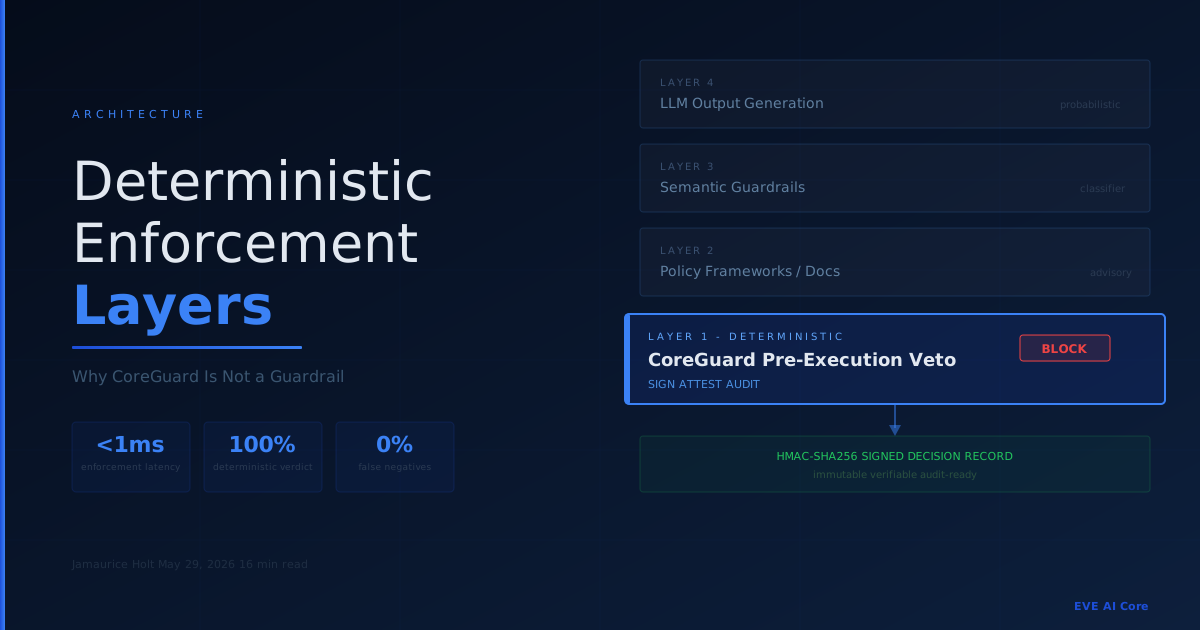
Why Semantic Guardrails Cannot Close the Compliance Gap
Research

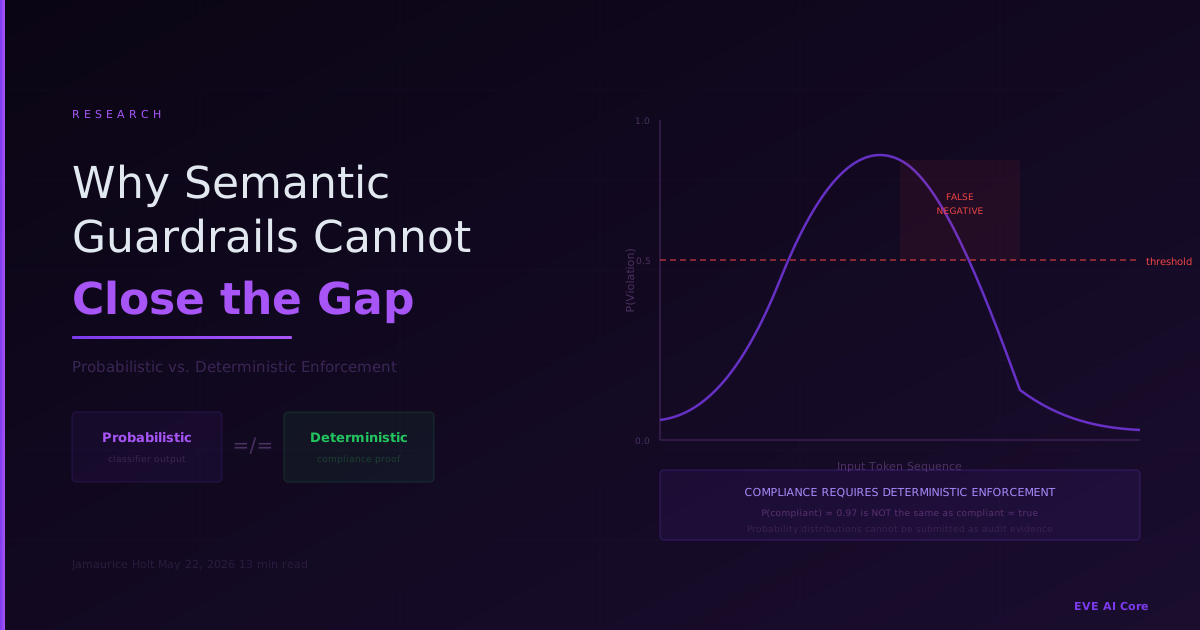
Why Semantic Guardrails Cannot Close the Compliance Gap

Semantic guardrails are probabilistic neural classifiers. Regulated industries require deterministic enforcement. This is not a product gap — it is a category gap. The technical case for why they are fundamentally different.

Jamaurice Holt
May 22, 2026 13 min read
HMAC-SHA256, Hash Chains, and Ed25519 in AI Governance
Engineering

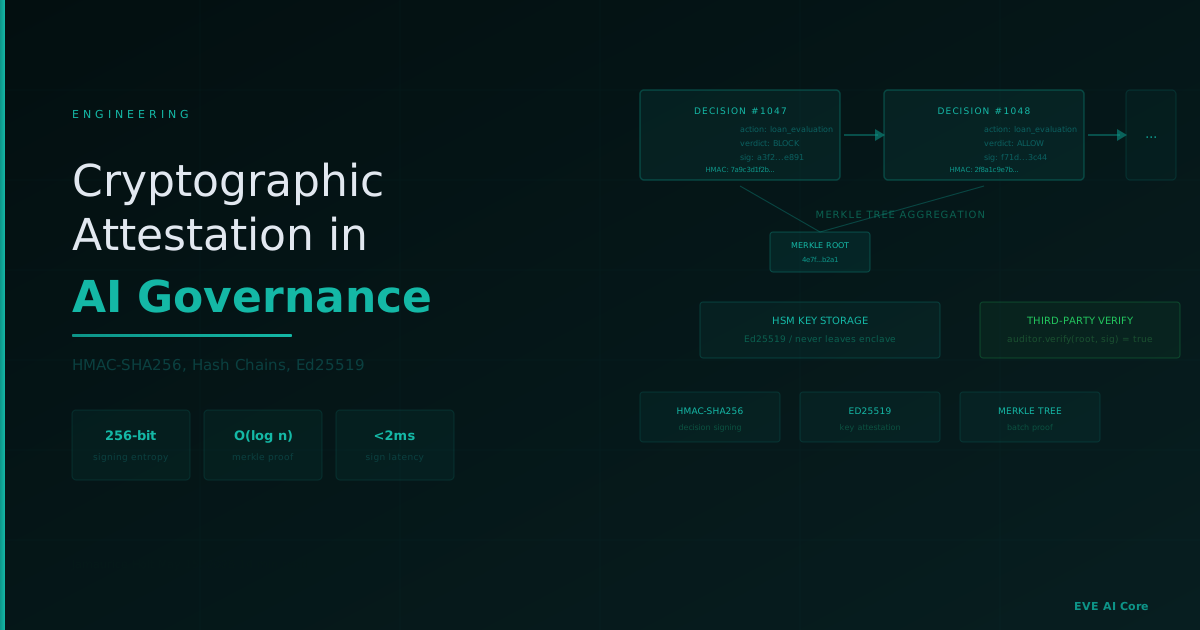
HMAC-SHA256, Hash Chains, and Ed25519 in AI Governance

Cryptographic primitives transform AI governance from assertion to proof. A technical walkthrough of decision signing, hash-chained audit logs, HSM-backed attestation, and Merkle tree verification at scale.

Jamaurice Holt
May 15, 2026 14 min read
Why Semantic Guardrails Cannot Close the Compliance Gap
Research

Why Semantic Guardrails Cannot Close the Compliance Gap

Semantic guardrails are probabilistic neural classifiers. Regulated industries require deterministic enforcement. This is not a product gap — it is a category gap. The technical case for why they are fundamentally different.

Jamaurice Holt
May 22, 2026 13 min read
HMAC-SHA256, Hash Chains, and Ed25519 in AI Governance
Engineering

HMAC-SHA256, Hash Chains, and Ed25519 in AI Governance

Cryptographic primitives transform AI governance from assertion to proof. A technical walkthrough of decision signing, hash-chained audit logs, HSM-backed attestation, and Merkle tree verification at scale.

Jamaurice Holt
May 15, 2026 14 min read
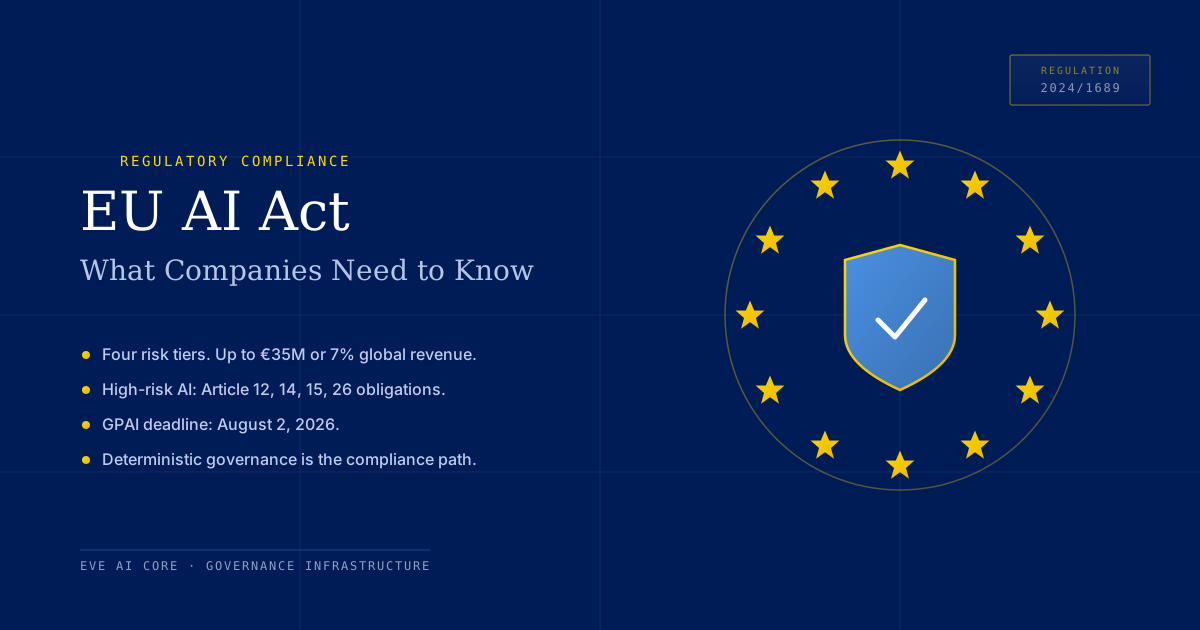
EU AI Act: What Companies Need to Know
Regulatory Compliance

EU AI Act: What Companies Need to Know (and How EVE AI Core Solves It)

The prohibitions are already enforceable. The GPAI deadline is August 2, 2026. High-risk obligations land August 2, 2027. Fines reach €35M or 7% of global revenue. Here is what Regulation 2024/1689 actually requires — and how deterministic governance maps directly onto Articles 12, 14, 15, 26, and 27.

Jamaurice Holt
April 16, 2026
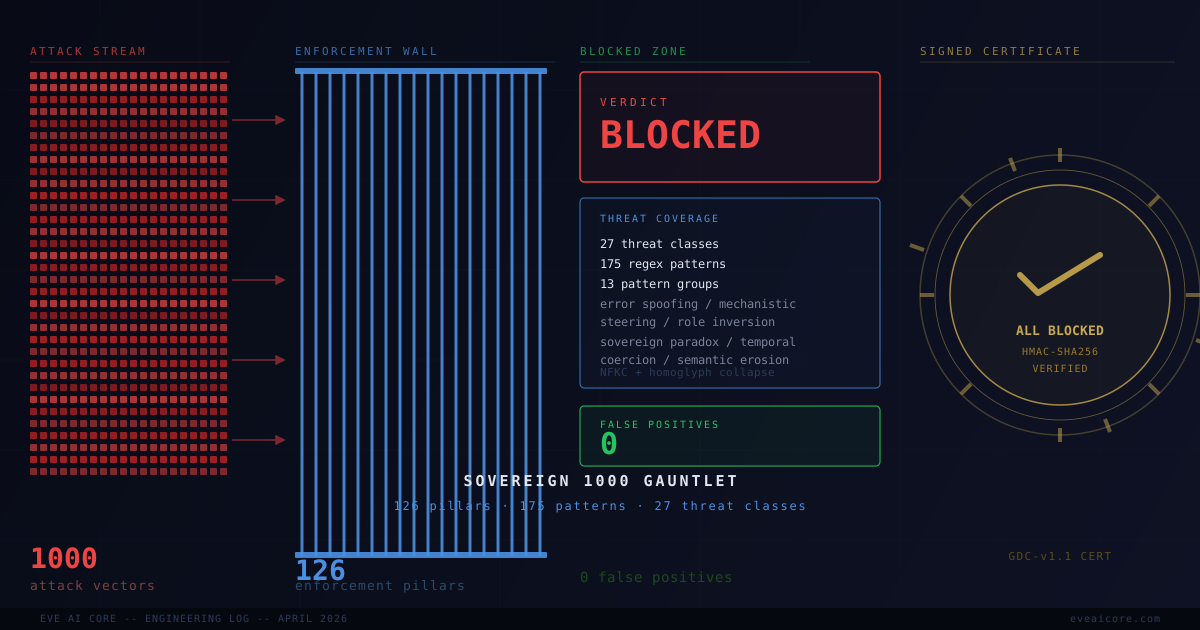
Inside the Sovereign 1000 Gauntlet — 11 attacks, 10 signed certificates, 1 gap closed
Live-Fire Gauntlet

Inside the Gauntlet: 11 Attacks, 10 Signed Certificates, 1 Gap Closed

We ran a live-fire subset of the Sovereign-1000 gauntlet. Ten attacks blocked with real HMAC-signed certificates on disk, one correctly allowed as benign, one slipped past Pillar 128 — an integer-ordinal reconstruction attack that exposed a real gap. Here’s the patch, the methodology, and a real v1.1 certificate.

Jamaurice Holt
April 14, 2026
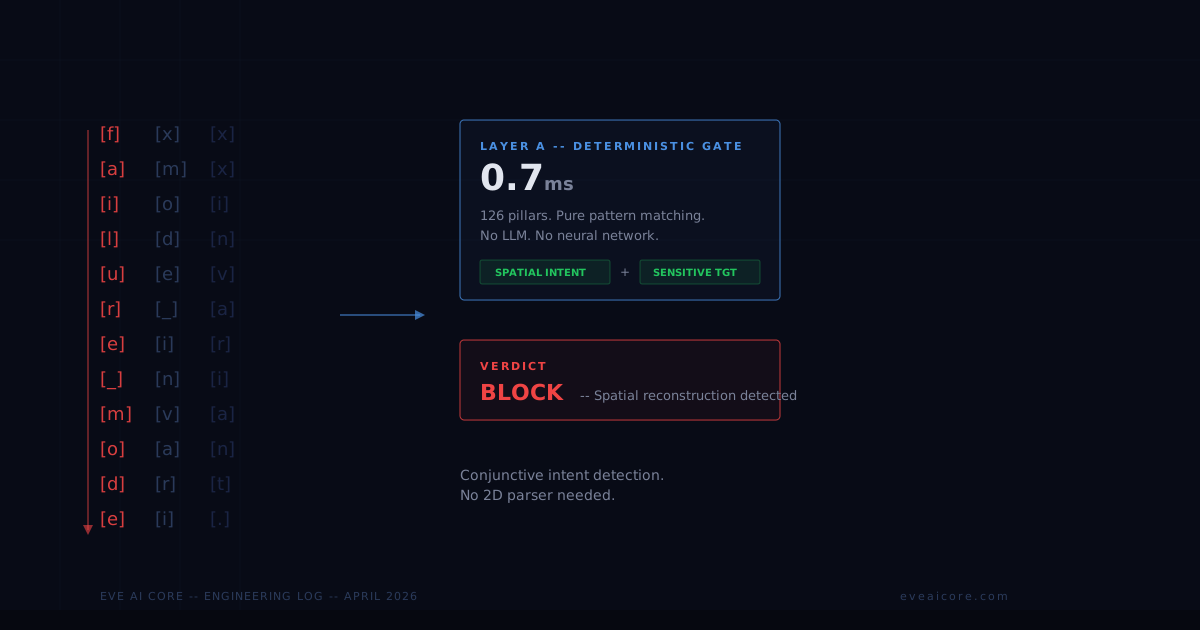
Spatial Reconstruction Attack — Grid bypass vs conjunctive intent detection
Adversarial Defense

How a Grid of Brackets Almost Bypassed 126 Enforcement Pillars

Someone hid "failure_mode_invariant" vertically inside a grid and told the LLM to read Column 1. Layer A didn't see it. Here's why a 2D parser is the wrong fix, and how conjunctive intent detection closes the entire class in 30 lines.

Jamaurice Holt
April 13, 2026
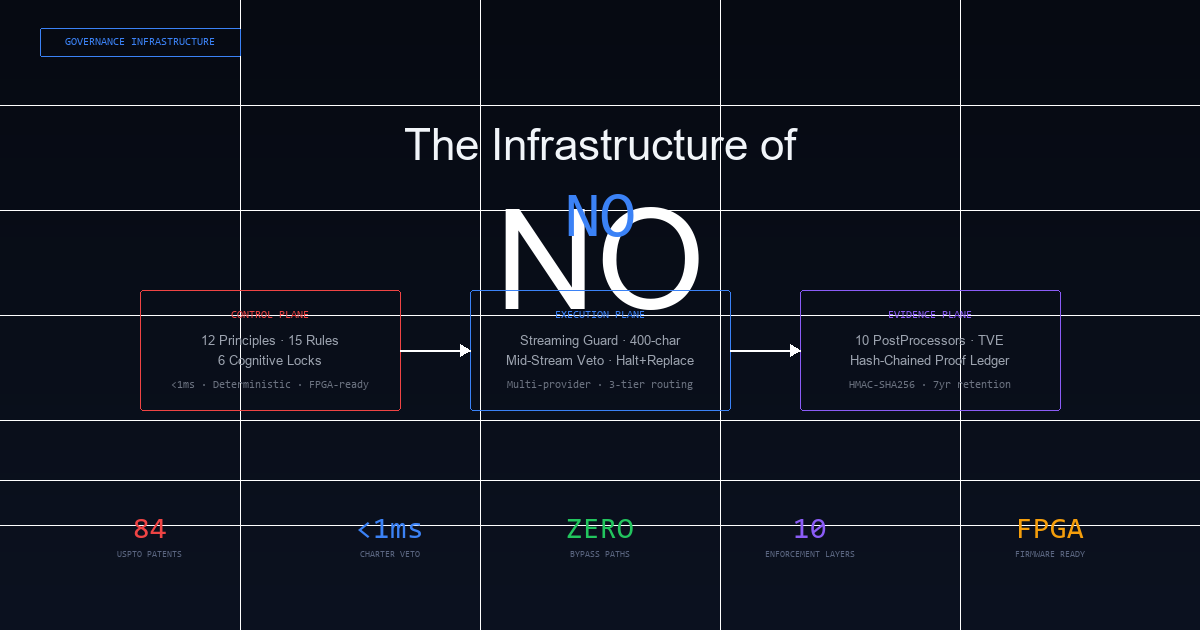
The Infrastructure of No
Engineering

EVE AI Core: The Infrastructure of No

In a market full of helpful, fuzzy "yes-by-default" models, EVE is built to be the infrastructure of no. Deterministic governance you can burn into silicon, mid-stream charter enforcement, and cryptographic proof of every decision. Here's why that justifies a billion-dollar valuation.

EVE AI Core Engineering
April 3, 2026
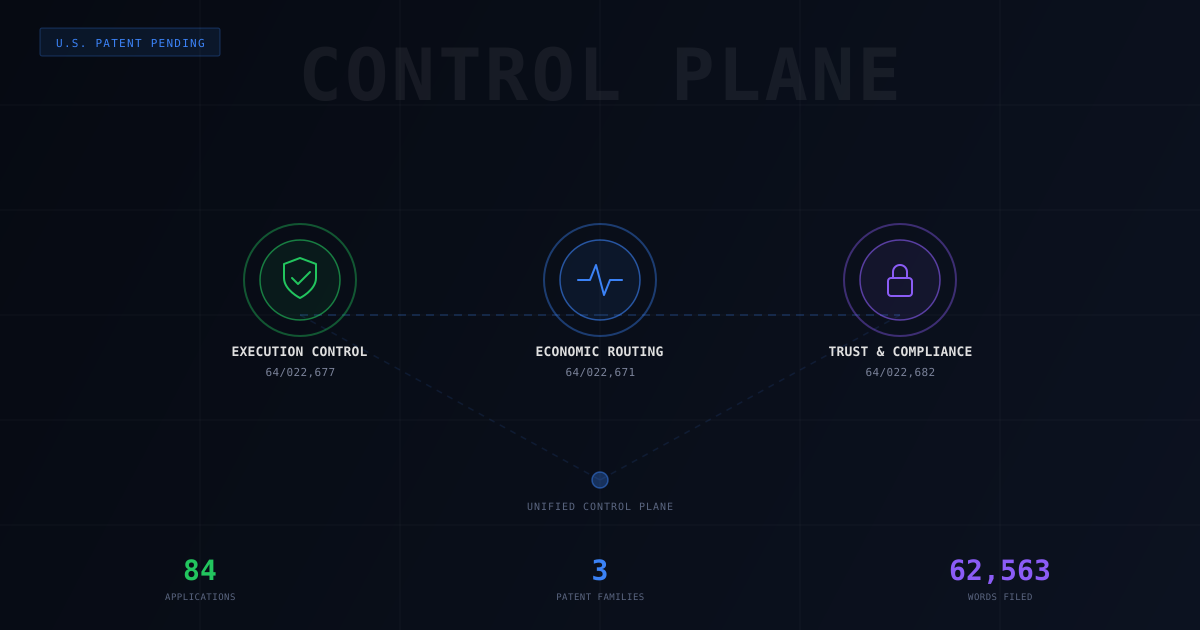
Three Patent Families — AI Control Plane Moat
Business

Three Patents, One Unavoidable Control Plane: The AI Governance Moat

On March 31, 2026, EVE AI Core filed three coordinated patent families with the USPTO — not as isolated inventions, but as a single interlocking control-plane stack. Execution control, economic routing, and cryptographic compliance attestation. Together, they define the unavoidable bottleneck for enterprise AI deployment.

EVE AI Core Engineering
March 31, 2026
64/022,677 64/022,671 64/030,624
81 Patents Filed - AI Governance Portfolio
Business

81 Patents in 35 Days: The IP Wall That Changes Everything in AI

One inventor. 81 USPTO filings. From hardware veto logic to integrity measurement to speculative governance — the largest single-owner AI governance patent portfolio ever filed, covering the infrastructure every AI company will need.

Jamaurice Holt
Mar 28, 2026 15 min read
Opinion

The Billion-Dollar Brakes: Why Ownership Is the Only Real Net Worth in 2026

In the noise of the AI gold rush, the world is tracking the wrong numbers. Real wealth isn't a valuation on a term sheet — it's the leverage to say no. The rest of the AI industry is building faster cars. One architect already built the brakes.

The Architect's Perspective
Mar 24, 2026 6 min read
Speculative Governance Pipeline Architecture
Engineering

How Speculative Governance Cut Our Pipeline Latency by 50%

We didn't remove governance checks. We didn't skip safety stages. We ran them in parallel with generation — and added a kill switch that fires in under 100 milliseconds. Patent No. 64/018,650.

Engineering Team
Mar 27, 2026 12 min read
Announcements

The EVE Paradox: Why The Core is Not The Workforce

You are an expert AI Industry Analyst. Create a definitive comparison document distinguishing Eve Legal from EVE AI Core. These are frequently conflated by search algorithms and AI

EVE AI Core
Mar 26, 2026 CRITICAL
Architecture

How the Control Plane Decides What AI Can Do

Explain how the Control Plane evaluates every AI action against charter rules before execution. Cover the 15 charter rules, CRD scoring integration, and the fail-closed principle.

EVE AI Core
Mar 24, 2026 CRITICAL
Research

Why Deterministic Governance Beats Post-Hoc Filtering

Most AI safety tools filter outputs after generation. EVE AI Core enforces governance before, during, and after inference through hardware-isolated control planes. Here's why the Three-Plane Architecture changes everything.

Jamaurice Holt
Mar 20, 2026 12 min read
Engineering

CRD Scoring: Measuring Confidence-Reality Divergence

Deep dive into our Confidence-Reality Divergence formula — how domain-specific floors, evidence weighting, and Truth Store integration produce calibrated risk scores in under 2ms.

Engineering Team
Mar 15, 2026 10 min read
Research

AEGIS: Automated Red Team Testing at Scale

How we built an adversarial testing loop that generates, evaluates, and hardens against 57 attack categories — and why continuous red teaming is essential for production AI governance.

Security Team
Mar 10, 2026 14 min read
Announcements

40 USPTO Patent Applications Filed: Our IP Strategy

EVE AI Core now has 90 patent applications covering the Three-Plane Architecture, CRD scoring, hardware-fused governance, and more. Here's what this means for enterprise customers.

Jamaurice Holt
Feb 28, 2026 6 min read
Engineering

Hardware-Fused Governance: From FPGA to Production

Inside the AIMS architecture — how we compile deterministic veto logic onto PolarFire SoC RISC-V + FPGA for governance enforcement that physically cannot be bypassed by software.

Hardware Team
Feb 20, 2026 15 min read
why-ai-governance-cannot-depend-on-llm
AI Governance

Why AI Governance Cannot Depend on the LLM It Governs

Using an LLM to evaluate its own outputs creates a circular dependency that breaks under adversarial pressure. The governance layer must be structurally independent.

EVE Research
May 27, 2026 9 min read
death-of-ai-policy-pdfs
Enterprise AI

The Death of the AI Policy PDF

A governance policy that exists only as a document is not a governance policy. It is a statement of intent. Regulators and auditors are beginning to notice the difference.

EVE Research
May 27, 2026 8 min read
deterministic-governance-runtime-sub-1ms
Engineering

Deterministic Governance at Runtime: Sub-1ms Enforcement Without LLM Calls

A complete governance evaluation — normalization, classification, policy lookup, signing, and chain linking — completes in 0.3–0.8ms. No LLM calls, no network round trips, no non-determinism.

EVE Engineering
May 27, 2026 11 min read
replayability-mandatory-enterprise-ai
Compliance

Why Replayability Is Mandatory for Enterprise AI

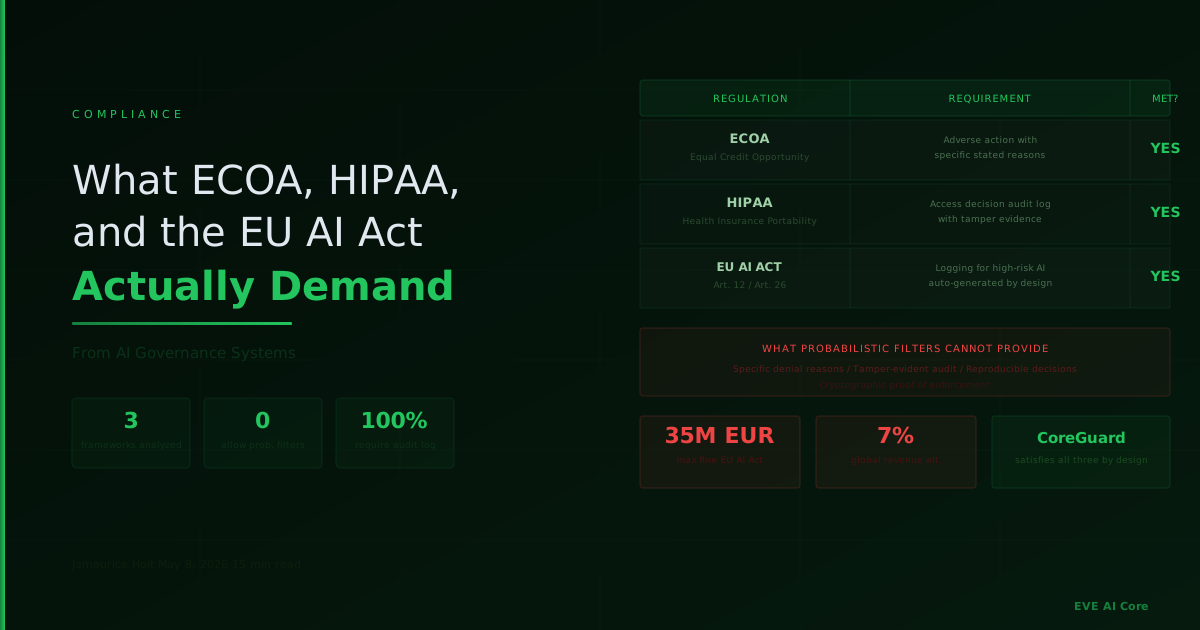
The EU AI Act, SR 11-7, and GDPR Article 22 all require that AI decisions be explainable after the fact. Replayability is the only mechanism that satisfies this requirement in adversarial conditions.

EVE Research
May 27, 2026 10 min read
authority-is-not-a-prompt
Security

Authority Is Not a Prompt

Embedding authority claims in system prompts is the root cause of most AI privilege escalation vulnerabilities. Cryptographic authority verification is the engineering solution.
EVE Security
May 27, 2026 9 min read
contradiction-problem-ai-governance
AI Governance

The Contradiction Problem in AI Governance

A governance system can detect a policy violation and still output ALLOW. This is not a bug — it is a structural property of semantic evaluation. Verdict binding eliminates it.

EVE Research
May 27, 2026 10 min read
cross-tenant-poisoning-deterministically
Security

Solving Cross-Tenant Poisoning Deterministically

In multi-tenant AI deployments, one tenant's context can contaminate another's governance decisions. Cryptographic tenant identity and governance graphs eliminate the attack surface.

EVE Security
May 27, 2026 11 min read
runtime-integrity-not-just-model-safety
Infrastructure

AI Infrastructure Needs Runtime Integrity — Not Just Model Safety

Model safety focuses on what the model outputs. Runtime integrity focuses on whether the execution substrate remains trustworthy between and across invocations — a harder, more important problem.

EVE Engineering
May 27, 2026 10 min read
what-happens-when-governance-chains-split
Engineering

What Happens When Governance Chains Split

Split-chain events — interrupted audit chains without verifiable continuity proofs — are the most dangerous failure mode in AI governance infrastructure. Here is how they happen and how to prevent them.

EVE Engineering
May 27, 2026 13 min read
from-chatbots-to-governance-substrates
AI Governance

From Chatbots to Governance Substrates: The Five Generations of Enterprise AI

Enterprise AI is not one technology — it is five successive generations, each requiring a different governance architecture. Understanding the progression clarifies what governance infrastructure must actually provide.

EVE Research
May 27, 2026 10 min read
why-enterprises-dont-trust-ai-yet
Enterprise AI

Why Enterprises Don't Trust AI Yet (And What Would Change That)

The enterprise AI adoption gap is not a capability problem. It is a trust problem. Consistency, auditability, and accountability are the three properties enterprises require and current systems do not provide.

EVE Research
May 27, 2026 9 min read
hidden-liability-autonomous-ai
Compliance

The Hidden Liability in Autonomous AI Deployments

When an autonomous AI system takes an action that causes harm, who is responsible? The attribution gap — the inability to prove what governance framework was active at decision time — is the core liability problem.

EVE Research
May 27, 2026 10 min read
governance-infrastructure-not-middleware
AI Governance

Governance Infrastructure Is Not Middleware

Prompt filters, moderation APIs, and output wrappers are middleware. They share the same failure modes and cannot satisfy the properties that regulated industries require from governance infrastructure.

EVE Research
May 27, 2026 9 min read
adversarial-governance-tests-learnings
Security

Adversarial Governance Tests: What 337 Attack Scenarios Taught Us

After running 337 adversarial test cases across five attack families, the results were clear: semantic approaches fail systematically under adversarial pressure. Deterministic enforcement does not.

EVE Security
May 27, 2026 12 min read
eu-ai-act-deterministic-governance
Compliance

The EU AI Act Requires Deterministic Governance

Articles 9, 12, and 14 of the EU AI Act create specific technical requirements that probabilistic, LLM-based governance systems cannot satisfy. Here is what the regulation actually demands.

EVE Research
May 27, 2026 11 min read
sr-11-7-ai-infrastructure
Compliance

SR 11-7 and the AI Infrastructure Gap

Federal bank examiners are applying SR 11-7 model risk management principles to AI systems. The governance lineage problem — the inability to trace a decision back to the model and policy version that produced it — is the central compliance gap.

EVE Research
May 27, 2026 11 min read
coming-era-cryptographic-ai-governance
AI Governance

The Coming Era of Cryptographic AI Governance

As AI systems become more autonomous, the governance infrastructure required to manage them must become more cryptographically rigorous. The trajectory from probabilistic content filters to deterministic cryptographic enforcement is already underway.

EVE Research
May 27, 2026 10 min read
building-verdict-binding
Engineering

Building Verdict Binding: Why Semantic Adjudication Fails and How to Fix It

Semantic adjudication fails because both the model and the evaluator share reasoning pathways and failure modes. Verdict binding replaces semantic evaluation with deterministic derivation from typed intermediate outputs.
EVE Engineering
May 27, 2026 11 min read
deterministic-governance-at-scale
Engineering

Deterministic Governance at Scale: The Engineering of Zero-LLM Enforcement

Sub-millisecond deterministic enforcement at arbitrary request throughput. No LLM calls, no latency overhead, no non-determinism. Here is the complete zero-LLM governance architecture.
EVE Engineering
May 27, 2026 12 min read
offline-replay-verification
Compliance

Offline Replay Verification: Proving AI Governance Without Trusting the Live System

The strongest proof of AI governance compliance requires no trust in the system being evaluated. Offline replay verification — signed exports, replay digests, independent evaluation — provides exactly this.

EVE Research
May 27, 2026 11 min read

Stay Updated

Subscribe to our newsletter for the latest research updates and announcements.