
The AI governance tools market has converged on a comfortable narrative: deploy semantic guardrails, add a moderation API, call it compliant. This narrative is being actively sold to regulated enterprises, and it is technically incorrect in a way that creates serious liability for the organizations that accept it.
Semantic guardrails — LlamaGuard, NeMo Guardrails, OpenAI Moderation, Guardrails AI — are genuinely useful tools. They reduce the probability of harmful outputs. They catch many prompt injection attempts. They filter obvious violations before content reaches users. None of this is disputed. What is disputed is whether probabilistic filtering satisfies the enforcement requirements of regulated industries. The answer is no, and the reasons are structural, not correctible by model improvements.
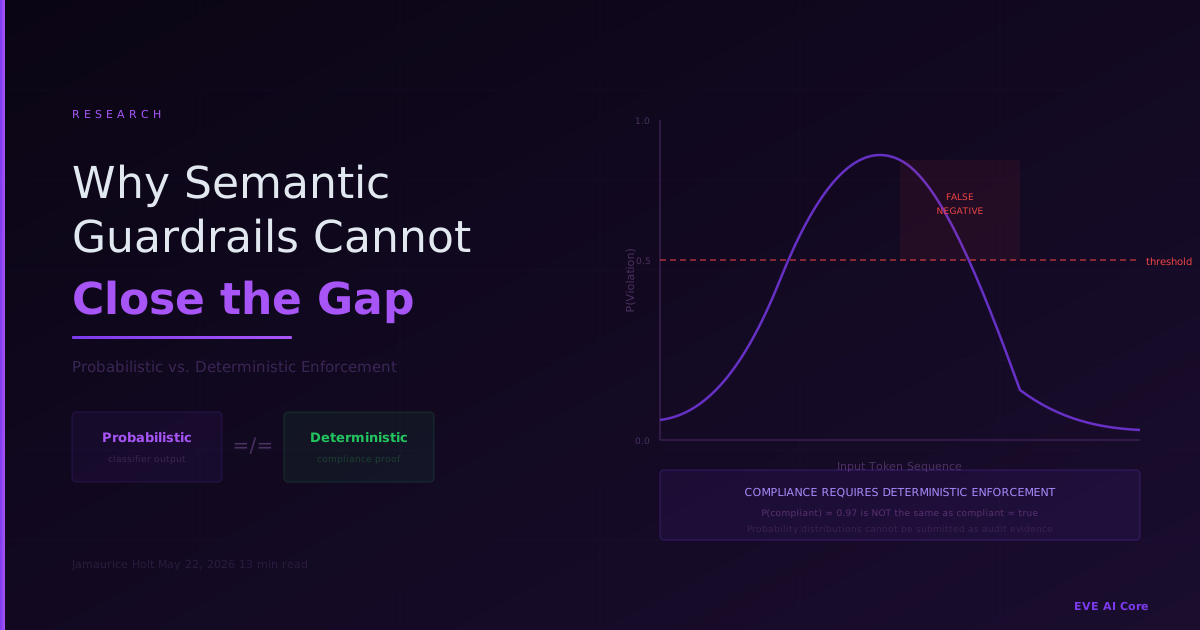
A system that is "usually correct" does not satisfy a compliance requirement. Compliance requirements are binary: the governance mechanism either provably enforced the policy, or it did not. Probability distributions cannot be submitted as audit evidence.
What Semantic Guardrails Actually Are
Semantic guardrails are neural classifiers. They accept text — a prompt, a model output, or both — and return a classification: safe/unsafe, allowed/denied, or a score within a harm taxonomy. The classification is produced by running the text through a fine-tuned language model whose weights encode a probabilistic approximation of policy intent extracted from labeled training examples.
This is a technically sound approach to a genuinely difficult problem. Natural language is ambiguous, context-dependent, and adversarially malleable. Training a model to classify it produces better outcomes than hand-crafted regex rules or keyword blocklists. The approach is valid. The category it belongs to is probabilistic content filtering, not policy enforcement.
The distinction is not semantic. It maps to a concrete architectural difference:
- Probabilistic content filtering — runs text through a neural classifier; produces a probability-weighted classification; has a false positive rate and a false negative rate; can be wrong on any given input
- Policy enforcement — evaluates a structured action against a compiled rule set; produces a deterministic verdict; the verdict is the same for the same input every time; the evaluation mechanism is separate from the thing being evaluated
Guardrail tools operate in the first category. Compliance requirements mandate the second.
The Probability Problem
Every semantic guardrail system has a false negative rate. This is not a product deficiency — it is a mathematical property of probabilistic classifiers. There will always exist inputs that the model classifies as safe that a human expert would classify as violating policy. This rate can be reduced through improved training, but it cannot be driven to zero without driving the false positive rate to impractical levels.
A false negative rate of even 1% is operationally significant at scale. A system processing 100,000 AI decisions per day at a 1% false negative rate produces 1,000 undetected policy violations daily. Over a quarter, that is approximately 90,000 compliance events with no audit record, no signed attestation, and no defensible chain of evidence.
Under adversarial conditions, performance degrades further. Semantic guardrails share the same semantic space as the model they are protecting. An adversary who understands the training distribution can craft inputs that encode prohibited content in ways the classifier has not seen, while remaining parseable by the target model. This is the fundamental security limitation of using a language model to police a language model.
Why "Good Enough" Is Not Good Enough in Regulated Domains
The probabilistic limitation might be acceptable in low-stakes deployments: a consumer chatbot, a creative writing tool, a general-purpose assistant. If the guardrail misses something, the cost is bounded and recoverable. In regulated industries, this calculus inverts.
The common thread across these domains is not that regulators hate probability. It is that regulatory frameworks are written around the concept of provable enforcement. A loan officer cannot testify that they "usually" followed ECOA. A healthcare system cannot document that its AI "probably" stayed within clinical scope. Regulatory compliance is binary: either you can demonstrate that your controls operated as required, or you cannot.
The Audit Record Problem
Even setting aside false negative rates, semantic guardrails have a second structural limitation: the audit record they produce is incomplete and unverifiable.
When a semantic guardrail classifies an input as safe and allows it to proceed, it typically produces a classification score and perhaps a harm category label. What it does not produce is:
- A cryptographically signed record of the exact policy set that was evaluated
- The version of that policy set at the time of evaluation
- A content hash of the input that was evaluated, binding the decision to that specific input
- A tamper-evident chain linking the decision to a sequence of prior decisions
- A verifiable assertion that the enforcement mechanism was the same mechanism that was tested and validated
Compliance auditors in regulated industries require all of these. They need to be able to reconstruct, months or years later, exactly what your system decided, why it decided it, and proof that the governance mechanism was operating correctly at the time.
A semantic guardrail can tell you what it decided. It cannot prove what policy set it was enforcing, whether that policy set was the approved version, or whether the same input evaluated a second time would produce the same result. Deterministic enforcement systems with cryptographic attestation can prove all of these things.
What Compliance Actually Requires
Translating compliance requirements into technical specifications reveals a consistent set of properties that regulated AI governance systems must exhibit:
| Requirement | Semantic Guardrail | Deterministic Enforcement |
|---|---|---|
| Same input, same decision — identical inputs must produce identical governance outcomes for audit reproducibility | ✗ Non-deterministic across model versions, temperature, context window | ✓ Guaranteed by pure-function evaluation against compiled rule set |
| Policy version binding — each decision must be cryptographically bound to the version of the policy that evaluated it | ✗ Model weights encode policy implicitly; no versioned policy artifact exists | ✓ Policy packs are versioned modules; each certificate includes policy version hash |
| Tamper-evident audit log — the complete decision history must be provably unmodified | ~ Some systems log decisions, but logs are not hash-chained or cryptographically signed | ✓ HMAC-SHA256 signed certificates in hash-chained log; tampering breaks chain |
| Enforcement separation — the mechanism enforcing policy must be architecturally separate from the model producing outputs | ✗ Guardrail model shares semantic space and failure modes with target model | ✓ Zero-dependency pure-function veto core; no LLM involvement in enforcement |
| Explainability — each enforcement decision must reference a specific rule that was triggered | ~ Harm category labels; no rule-level citation | ✓ Each blocked decision cites the specific rule ID, principle, and policy pack section |
| Pre-execution enforcement — policy must be evaluated before the action executes, not after output is generated | ✗ Most guardrails evaluate output after generation; some evaluate input but not action | ✓ Evaluation occurs before model invocation; blocked decisions never reach LLM |
The Category Error in AI Governance Discourse
The confusion between semantic guardrails and governance enforcement persists because the tools are deployed in adjacent positions in AI system architectures, and marketing language collapses the distinction. A tool that "guards" against harmful outputs sounds like a governance tool. A tool that "enforces" content policy sounds like an enforcement tool. The words activate the same cognitive schema.
But the architectural positions are different, the guarantees are different, and the compliance properties are different. Semantic guardrails reduce the probability of harmful outputs passing through. Governance enforcement systems produce a cryptographically verifiable record proving that every input was evaluated against a specific versioned policy before any output was generated.
These are not competing products. They address different problems at different layers. The error is treating one as a substitute for the other — specifically, treating probabilistic filtering as if it satisfies the deterministic enforcement requirements of compliance frameworks.
Semantic guardrails belong at the content layer: reducing harm probability, catching obvious violations, filtering low-quality outputs. Deterministic enforcement belongs at the governance layer: enforcing versioned policy, producing signed audit records, guaranteeing consistent decisions. Both layers can coexist and should. Neither replaces the other.
What the Deterministic Alternative Looks Like
A deterministic enforcement system evaluates each AI action against a compiled policy set using pure functions — code with no non-deterministic elements, no external calls, no model inference. The policy set is a versioned artifact with a content hash. The evaluation produces one of three dispositions: ALLOWED, BLOCKED, or MODIFIED.
Each disposition is wrapped in a Decision Certificate: a structured document containing the input content hash, the disposition, the policy version hash, the specific rules triggered (for BLOCKED and MODIFIED), a timestamp, and an HMAC-SHA256 signature. Certificates are appended to a hash-chained audit log where each entry includes the SHA-256 hash of the previous entry. Tampering with any record breaks the chain, making any modification detectable through independent chain verification.
The enforcement function itself — the code that evaluates rules — operates with zero I/O, zero threading, zero global state, and zero imports outside the standard library's type system. The same input, evaluated against the same policy version, produces the same output every time. This is what determinism means in the governance context: not "we use a fast model" but "the evaluation function is a pure mathematical function."
This architecture produces something that probabilistic filtering cannot: a defensible audit trail that proves, not just asserts, that governance controls operated correctly on every decision. When a regulator or auditor asks what your AI system was doing on March 15th, you can produce a verifiable certificate for every decision made that day, with the policy version it was evaluated against, and a cryptographic proof that the record has not been modified.
Practical Implications for Enterprise AI Deployments
Organizations deploying AI in regulated contexts should approach the tooling question by first identifying which requirements apply to their deployment, then selecting tools that satisfy those requirements — not the reverse.
If the compliance requirement is "reduce probability of harmful outputs," semantic guardrails are an appropriate solution. If the compliance requirement is "demonstrate that every AI decision was evaluated against approved policy and produce a tamper-evident audit record," semantic guardrails do not satisfy the requirement, regardless of their quality or sophistication.
The practical risk of the current market confusion is that organizations deploy semantic guardrails, document them as their AI governance controls, and then discover — during a regulatory examination or an adverse event — that probabilistic filtering does not constitute a governance control. The gap between what was deployed and what the regulation required was not a product gap. It was a category error made at the architecture design stage.
The category error typically surfaces at the worst possible time: during a regulatory examination after an incident. "We had semantic guardrails deployed" is not a response to "show us the audit trail proving your AI system enforced your fair lending policy on every loan decision in Q3." The audit trail either exists or it does not. Probability does not retroactively become proof.
Conclusion
Semantic guardrails are valuable tools that do what they are designed to do: reduce the probability of harmful AI outputs by applying learned classifiers to content. The compliance gap they cannot close is not a failure of the tools. It is a structural consequence of probabilistic classification being a different property from deterministic enforcement.
Regulated industries require deterministic enforcement: same policy, same input, same decision, cryptographically signed, version-bound, hash-chained, and independently verifiable. These requirements were not written by people who expected AI governance to be solved by content classifiers. They were written to ensure that automated systems operating in high-stakes domains produce decisions that can be proven, not merely described as probably correct.
The gap is real. It is category-level, not product-level. And it will not be closed by improving the semantic guardrail models.