
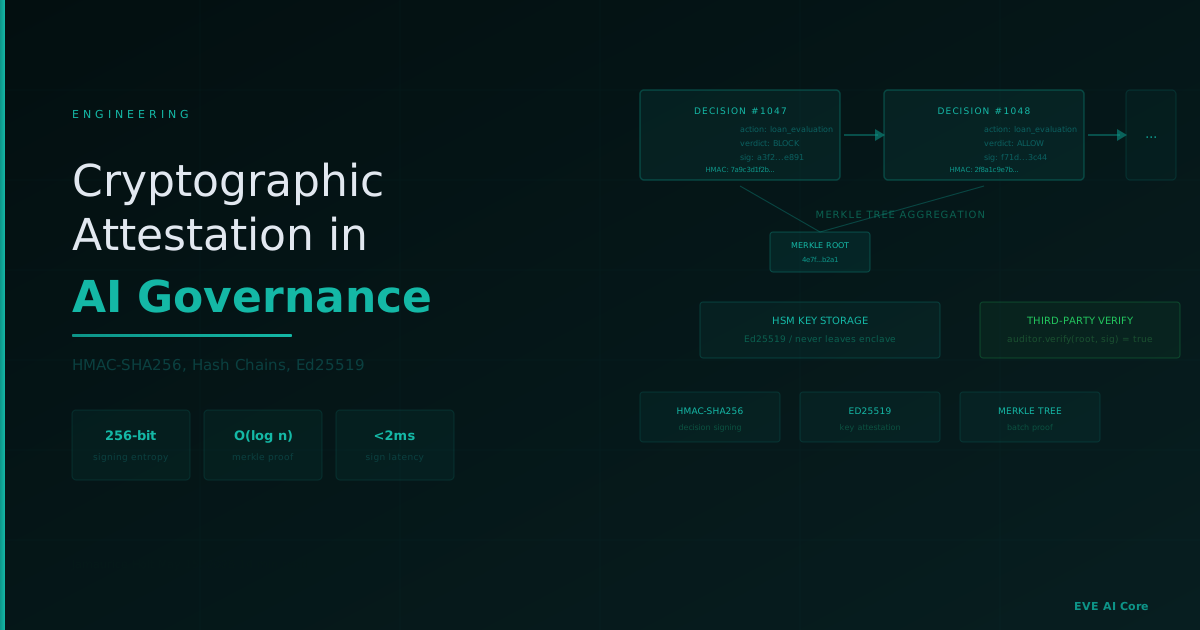
AI governance is moving through a maturation inflection. The first generation of governance tooling — content classifiers, moderation APIs, semantic guardrails — addressed the problem of harmful outputs with probabilistic filtering. The second generation adds a requirement that the first did not attempt to satisfy: proof.
Proof, in the compliance sense, means the ability to demonstrate cryptographically that a specific decision was made, under a specific policy, at a specific time, and that the record of that decision has not been modified. This is not a philosophical requirement. It is a practical requirement imposed by regulators, auditors, and enterprise security policies that have dealt with the tamper-evidence problem in other domains — financial transactions, access logs, software supply chains — and are now applying the same requirements to AI decision systems.
This article explains the three cryptographic primitives that compose a verifiable AI governance record: HMAC-SHA256 for decision signing, hash chains for audit log integrity, and Ed25519 for HSM-backed high-assurance contexts. It explains how these primitives combine into a system that transforms governance from assertion to proof.
This article covers applied cryptography in the context of AI governance infrastructure. It assumes familiarity with basic cryptographic concepts (hash functions, MACs, public key cryptography) but does not require deep cryptographic background.
Why AI Governance Needs Cryptography
Consider what it means to claim that your AI system "enforced your lending policy on every loan application." Without cryptographic attestation, this claim rests on log files that can be modified, configuration states that can be changed retroactively, and system documentation that says what the system was supposed to do rather than what it did.
An auditor reviewing this claim has no mechanism to verify it independently. They can review your documentation and trust that it accurately describes the system. They can run spot tests and trust that the system behaves consistently when tested. They cannot verify that the system behaved as documented on March 15th, or that the log files showing March 15th decisions have not been modified since then.
Cryptographic attestation closes this gap. When a decision is signed at the moment of generation, the signature binds the decision record to a specific signing key. When decisions are appended to a hash-chained log, each entry is bound to the complete prior history. An independent party can verify both the decision signature and the chain integrity without trusting the system that generated them. The proof is in the mathematics, not in trust relationships.
HMAC-SHA256: Signing Individual Decisions
HMAC (Hash-based Message Authentication Code) applies a cryptographic hash function to a message combined with a secret key, producing a fixed-length tag. The HMAC-SHA256 variant uses SHA-256 as the underlying hash function, producing a 256-bit tag.
In the context of AI governance, HMAC-SHA256 is used to sign Decision Certificates: the structured records produced when a governance system evaluates an AI action. The process is:
- Assemble the decision record as a canonical JSON document (JSON Canonicalization Scheme, RFC 8785)
- Compute HMAC-SHA256 over the canonical bytes using the governance signing key
- Attach the hex-encoded MAC as the
signaturefield of the certificate - Store both the certificate and the signature in the audit log
{
  "decision_id": "dec_a1b2c3d4",
  "timestamp": 1748102400.471623,
  "policy_set": "lending_v1",
  "policy_version_hash": "sha256:4a6f8b2c...",
  "input_hash": "sha256:e3b0c44298fc...",
  "disposition": "BLOCKED",
  "risk_level": "HIGH",
  "triggered_rules": [
    {
      "rule_id": "lending_v1.ecoa.protected_class_proxying",
      "severity": "HIGH",
      "description": "ZIP code used as protected-class proxy"
    }
  ],
  "prev_hash": "sha256:8f3e1a94...",  // chain link
  "signature": "hmac-sha256:7f83b1657ff1fc53b92dc18..."
}
Verification is symmetric: recompute HMAC-SHA256 over the canonical certificate bytes using the same key; compare the output to the stored signature. If they match, the certificate has not been modified and was produced by an entity holding the signing key. If they do not match, the certificate has been tampered with.
Why Canonicalization Matters
JSON does not have a canonical representation. {"a":1,"b":2} and {"b":2,"a":1} are semantically identical but byte-for-byte different. If a governance system serializes the same record in different key orders at different times, signatures computed over the serialized bytes will not be reproducible. This would make verification impossible.
RFC 8785 (JSON Canonicalization Scheme) specifies a deterministic JSON serialization: keys are sorted lexicographically, Unicode characters are encoded consistently, whitespace is normalized. All governance records signed with HMAC-SHA256 must be canonicalized before signing. The same record, canonicalized with RFC 8785, produces the same bytes every time, making signatures reproducible and verifiable.
Using json.dumps(record, sort_keys=True) is not sufficient. Python's json.dumps sorts keys alphabetically, but does not handle all Unicode normalization cases required by RFC 8785. Production governance systems should use a dedicated JCS implementation. EVE CoreGuard uses core/governance/jcs_canonicalize.py which implements the full RFC 8785 specification.
Key Management for HMAC
HMAC is a symmetric primitive: the same key is used for signing and verification. This means the signing key must be protected. If the signing key is compromised, an adversary can forge valid-looking signatures for fabricated decision records. Best practices for HMAC key management in governance contexts:
- Store the signing key in an HSM or secrets manager (not in environment variables or config files)
- Rotate the key periodically and record the rotation event in the audit log with a signed key rotation certificate
- Use a separate signing key from application-level keys (session keys, JWT secrets)
- Limit signing key access to the governance enforcement process only
Hash Chains: Proving Audit Log Completeness
A Decision Certificate signed with HMAC-SHA256 proves that an individual record has not been modified. It does not prove that records have not been deleted from the audit log, or that records have not been inserted into the audit log between two existing records. Hash chains address both problems.
A hash-chained audit log embeds the SHA-256 hash of the previous entry into each new entry before signing. This creates a chain: entry N contains prev_hash = SHA-256(entry[N-1]). If any entry is deleted, modified, or if an entry is inserted between two existing entries, the chain breaks — the prev_hash stored in the next entry will not match the computed hash of the modified or missing entry.
Chain verification is straightforward: walk the log from first to last entry, computing SHA-256 of each entry and comparing it to the prev_hash stored in the next entry. If every comparison succeeds, the chain is intact. If any comparison fails, the chain has been tampered with, and the failure point identifies where the tampering occurred.
Chain Verification in Practice
For an audit log containing millions of entries, full O(N) verification may be impractical for routine checks. Two optimizations address this:
Merkle tree aggregation — batch entries into Merkle trees and publish signed Merkle roots periodically. To verify a specific entry, retrieve the Merkle proof for that entry (O(log N) hashes) and verify the proof against the published root. This reduces per-entry verification cost without weakening tamper-evidence guarantees.
Checkpoint signing — periodically sign the current chain head hash with a timestamp. Checkpoints prove the chain existed and was intact up to that point, reducing the scope of any full verification to the period since the last checkpoint.
Ed25519: Asymmetric Signing for High-Assurance Contexts
HMAC-SHA256 is a symmetric primitive: the same key signs and verifies. This makes it efficient but requires that the verifier possess the signing key. For external verification scenarios — independent auditors, regulatory examiners, counterparties — the verifier should not need access to the signing key.
Ed25519, an Edwards-curve digital signature scheme, is an asymmetric alternative. The governance system holds a private key (never shared). The corresponding public key is published. Anyone with the public key can verify signatures without access to the private key. This enables genuinely independent verification.
Ed25519 was chosen over RSA and ECDSA for AI governance contexts for several reasons: the signature size is compact (64 bytes vs. 256+ bytes for RSA-2048); verification is fast; the key size is small (32 bytes private, 32 bytes public); and the algorithm has a clean security proof under the discrete logarithm assumption without the parameter choices that create implementation pitfalls in ECDSA.
HSM Integration
For high-assurance deployments, both HMAC and Ed25519 private keys should be stored in a Hardware Security Module (HSM). An HSM stores private key material in tamper-resistant hardware and exposes only a signing API — the key never leaves the module in plaintext. This means that even if the application server is compromised, the attacker cannot extract the signing key and fabricate historical decisions.
The signing flow with HSM integration:
- Canonicalize the decision certificate (RFC 8785)
- Send the canonical bytes to the HSM via PKCS#11 or equivalent API
- Receive the signature from the HSM (the HSM computed the signature internally)
- Attach the signature to the certificate
- Append to the hash-chained audit log
This flow adds approximately 1–5 milliseconds per signing operation depending on the HSM vendor and protocol. For governance systems operating at thousands of decisions per second, HSM throughput may become a bottleneck and can be addressed with HSM clustering.
Composing the Verifiable Governance Record
The three primitives compose into a layered guarantee system:
- SHA-256 input hashing — binds each decision to a specific input. If the input changes, the hash changes. The input hash in the certificate proves what was evaluated.
- SHA-256 policy version hashing — binds each decision to a specific version of the policy set. Policy changes create a new version hash. Auditors can verify which policy was active on any date.
- HMAC-SHA256 certificate signing — proves each certificate has not been modified since signing. Signature verification is O(1) per certificate.
- SHA-256 hash chain — proves the audit log is complete and unmodified. Chain verification proves no entries have been inserted, deleted, or modified. Chain verification is O(N).
- Ed25519 signatures — enable third-party verification without shared key access. Published public keys allow auditors to independently verify any certificate.
An AI governance system using all five layers can prove, to any party holding the public key: exactly what was decided; what input triggered the decision; which policy version was active; that the record has not been modified; and that the audit log is complete with no entries deleted. This is what "cryptographic attestation" means in practice.
Merkle Trees and Scalable Verification
At enterprise AI scale — millions of decisions per day — full chain traversal for every audit query is impractical. Merkle trees solve the scalability problem without weakening guarantees.
A Merkle tree aggregates a batch of decision hashes into a binary tree structure where each parent node is the hash of its two children. The root hash — a single 32-byte value — commits to all entries in the batch. To prove that a specific decision is included in a batch, a verifier needs only the O(log N) sibling hashes on the path from the leaf to the root. These sibling hashes constitute a Merkle proof.
Published Merkle roots, signed with Ed25519 and timestamped, allow an auditor to:
- Verify the root signature against the published public key
- Request the Merkle proof for any specific decision
- Verify the proof in O(log N) time
- Conclude that the decision was included in the batch committed by the signed root
This reduces per-decision verification cost from O(N) to O(log N) while maintaining the same tamper-evidence properties.
Algorithm Agility and Forward Security
Cryptographic algorithm recommendations change over time. SHA-256 and Ed25519 are both currently considered strong, but production governance infrastructure must be designed to migrate algorithms without invalidating historical audit records.
Algorithm agility in governance systems means maintaining a policy record of which algorithm was active for which time period, and designing the signature format to include an algorithm identifier. When verifying historical records, use the algorithm that was active at the time of signing, as identified by the algorithm field in the certificate.
Post-quantum considerations are relevant for long-lived audit records. NIST-standardized post-quantum algorithms (CRYSTALS-Dilithium for signatures, CRYSTALS-Kyber for key encapsulation) are candidates for future migrations. A governance system designed with algorithm agility can migrate to post-quantum primitives without re-signing historical records, provided the historical signatures were valid at the time of signing.
Practical Implementation Considerations
Several implementation details determine whether a cryptographic attestation system provides its theoretical guarantees in practice:
Key rotation cadence. HMAC keys should be rotated periodically (quarterly to annually depending on risk profile). Each rotation creates a new epoch. Audit records specify which epoch key they were signed with. Old epoch keys must be retained for verification of historical records.
Timestamp precision and clock synchronization. Decision certificates include timestamps for time-ordering and regulatory compliance. Use monotonic timestamps from a trusted time source (NTP synchronized, with drift monitoring). Inconsistent timestamps weaken the temporal ordering properties of the audit log.
Atomic append semantics. Hash-chained logs require that each append operation be atomic: the prev_hash of the new entry must equal the hash of the most recent existing entry. Concurrent writes without proper locking can produce branched chains that violate the linear ordering requirement. Use an append-only log store that provides atomic append guarantees.
Backup and recovery. The signing key and the audit log must be backed up independently with different access controls. An attacker who compromises both the signing key and the audit log can rewrite history. If the backup contains a copy of the chain at a prior state, historical tampering becomes detectable.
Cryptographic attestation provides strong tamper-evidence when the signing key is protected. If the signing key is stored alongside the data it signs — in the same database, the same server, the same secrets manager entry — the tamper-evidence guarantee is weakened. HSMs provide hardware-level key custody that eliminates this risk.
Conclusion
Cryptographic attestation in AI governance is not an enhancement to standard governance practice. It is the mechanism that transforms governance from documentation-based assertion to mathematically verifiable proof. HMAC-SHA256, hash chains, and Ed25519 are the primitives that compose this proof. Their application to AI decision records creates audit trails that can be verified by any party, at any time, without trusting the system that produced them.
The investment required to implement these primitives is modest relative to their compliance value. The signing and hashing operations add sub-millisecond overhead per decision. The verification capability they provide is the difference between "we believe our AI system enforced policy correctly" and "here is a cryptographic proof that it did."
For regulated enterprises deploying AI, that difference is the compliance gap.