
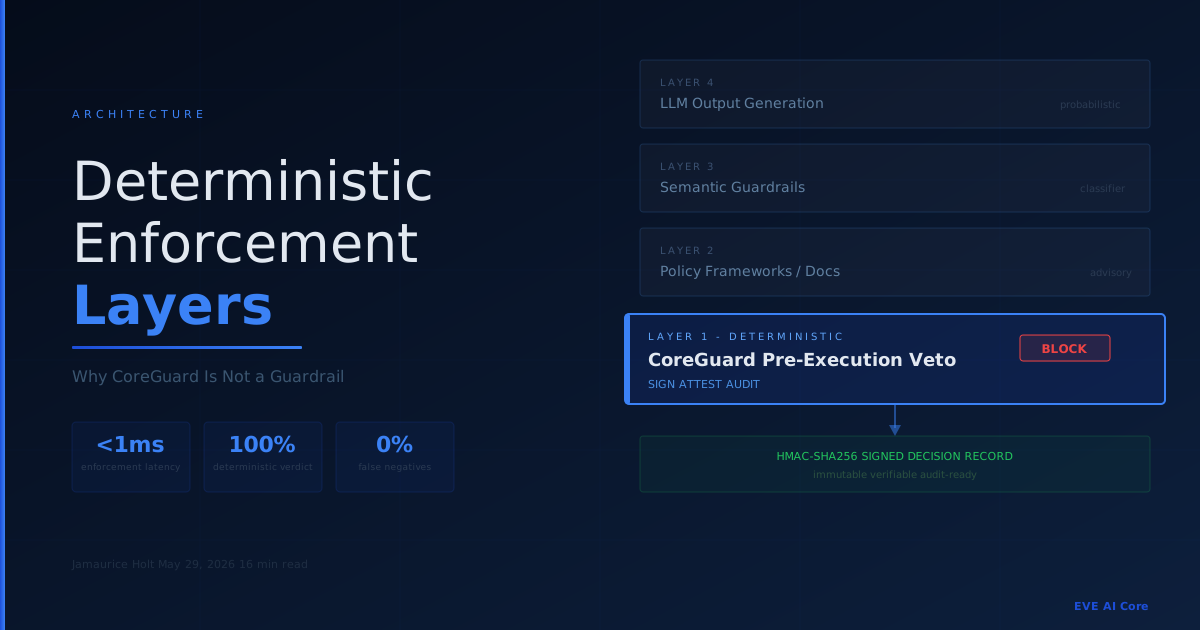
Enterprise AI buyers evaluating governance tooling face a fundamental taxonomy problem. The market conflates four distinct categories under a single umbrella — "AI safety" — producing apples-to-submarines comparisons that lead to architectural mismatch, compliance gaps, and audit failures.
The four categories are:
- Semantic guardrails — probabilistic content filters applied around model output
- Prompt-security tools — input scanners targeting injection, jailbreaks, and adversarial prompts
- Governance frameworks — regulatory and standards bodies (NIST AI RMF, ISO 42001, EU AI Act)
- Deterministic pre-execution enforcement systems — policy-compiled gate layers that evaluate and attest decisions before model invocation
EVE CoreGuard belongs to the fourth category. It does not appear on lists of "top AI guardrail tools" for the same reason that a circuit breaker does not appear on lists of "top electrical monitoring dashboards." They solve different problems at different layers of the stack, and conflating them is an architectural error with compliance consequences.
Key Distinction
Semantic guardrails answer: "Does this content violate our policy?" Deterministic enforcement answers: "Is this action authorized under policy version 2.3 as of today's effective date — and can I prove it?" These are not the same question.
Part I: Mapping the Landscape
Semantic Guardrails
Semantic guardrails — exemplified by Meta's LlamaGuard, NVIDIA's NeMo Guardrails, and OpenAI's Moderation API — are inference-time classifiers that evaluate text for policy violations. Their operating principle is fundamentally probabilistic: a second neural model is applied to either the user input, the model output, or both, and produces a score or label indicating whether the content falls within acceptable bounds.
User Input → [LLM] → Output → [Classifier: LlamaGuard] → Score → Route/Block
The classifier is itself a language model, fine-tuned on labeled examples of harmful, unsafe, or policy-violating content. It operates on semantic meaning — it understands that "how do I hurt someone" and "what are some ways to cause harm" are semantically similar, even if lexically different.
What they are good at: catching common categories of harmful output (hate speech, CSAM, direct violence instructions) and reducing surface-level policy violations in consumer applications.
What they are not: Semantic guardrails are not deterministic. The same input can produce different outputs across runs. They cannot produce a cryptographic proof that a specific decision was made at a specific time under a specific policy version. They cannot tell a financial regulator, healthcare auditor, or government contracting officer exactly why a decision was made, what policy version was active, and who authorized it.
The Compliance Gap
When a bank's AI system approves a loan, the Fair Housing Act requires that the decision be explainable, reproducible, and auditable. "The guardrail scored 0.23 on run #1 and 0.31 on run #2" is not a compliance answer. Semantic guardrails were designed for consumer content safety, not regulated transaction enforcement.
Prompt-Security Tools
Prompt-security tools — including Rebuff, LakeraGuard, and various OWASP-aligned scanners — focus on the input side of the inference pipeline. Their goal is to detect prompt injection, jailbreak attempts, data exfiltration patterns, and adversarial manipulation of the context window.
These tools typically combine rule-based pattern matching with lightweight classifiers trained on adversarial prompt datasets. They are attack-surface reducers, not governance enforcement layers. They answer the question "is this input adversarial?" not "is this action authorized under policy version 2.3 as of today's effective date, and can I prove it?"
Governance Frameworks
NIST AI RMF, ISO/IEC 42001, the EU AI Act, DORA, and equivalent regulatory instruments define what must be true about an AI system: that it has been risk-assessed, that its training data has been documented, that it has human oversight mechanisms, that high-risk uses have conformity assessments, that audit trails exist.
They do not enforce anything at runtime. They are assessment and documentation frameworks, not enforcement mechanisms. This is precisely the gap that deterministic enforcement layers exist to close. Governance frameworks tell you what your enforcement architecture must demonstrate. They do not build that architecture for you.
Deterministic Pre-Execution Enforcement Systems
This is the category that the previous three do not occupy. A deterministic pre-execution enforcement system evaluates a proposed AI action — before model invocation or before output delivery — against a compiled policy set, produces a cryptographically signed decision record, and returns one of a finite set of dispositions: ALLOWED, BLOCKED, or MODIFIED. The evaluation is deterministic: given the same inputs, it produces the same output, every time, without exception.
This is not a classifier. It is not a risk score. It is an enforcement gate.
Part II: Why Deterministic Enforcement Is a Distinct Category
The Determinism Requirement
Consider what an auditor actually needs from an AI governance system:
- Reproducibility: Given the input at time T, can you reproduce the decision exactly?
- Traceability: Can you identify which policy rule caused the decision?
- Integrity: Can you prove the decision record has not been altered?
- Policy version binding: Can you prove which version of the policy was active at time T?
Probabilistic systems cannot satisfy any of these requirements reliably. A neural network classifier does not produce the same output deterministically across hardware variations, floating-point precision differences, or model version updates. It cannot tell you which rule caused its output because it has no rules — it has weights. It cannot be cryptographically bound to a policy version because it is a statistical model, not a policy engine.
Deterministic enforcement systems satisfy all four requirements by design. They implement policies as compiled, version-controlled rule sets. They produce signed decision records. They maintain hash-chained audit logs that prove integrity. They bind decisions to the policy pack version that was active at evaluation time.
The Pre-Execution Requirement
Post-hoc filtering (applying a guardrail to model output) means the model has already processed the request. In agentic systems with tool use, post-hoc filtering fails catastrophically. If an AI agent has already called an external API, written to a database, or sent a message, filtering the output does nothing to prevent the side effect.
Pre-execution enforcement evaluates the proposed action before any model invocation occurs, before any tool call is dispatched, and before any side effect can propagate. The gate runs before the model, not after.
Action Intent → [Enforcement Gate: Policy Evaluation] → ALLOWED/BLOCKED/MODIFIED
                                                                    ↓
                                                          [Model / Tool — only if ALLOWED]
This is the only architecture that can provide meaningful governance in agentic AI systems.
Part III: EVE CoreGuard — Architecture of Deterministic Enforcement
The Veto Core: Pure Determinism by Design
The architectural anchor of CoreGuard's determinism is core/governance/veto_core.py — a 1,542-line module containing all veto logic with a hard constraint: zero imports outside dataclasses, enum, and typing.
By importing nothing from the runtime stack — no networking, no database access, no threading primitives — the veto core achieves a property critical for governance systems: it is a pure function. Given the same inputs, it produces the same outputs, on any hardware, in any environment, at any time.
The veto core exposes three pure entry points:
# 1. Charter compliance check — 14 rules, 12 principles
result = check_charter(action_type, action_params, context)
# Returns: CharterVetoResult(compliant, veto_type, violated_principles, ...)

# 2. Cognitive lock gate — 6 locks with risk-scaled thresholds
verdict = check_cognitive_locks(request, state)
# Returns: LockVerdict(approved, blocked_locks, conditional_locks)

# 3. Drift budget enforcement — protected invariants + window budgets
result = check_drift_budget(category, cost, target, budget)
# Returns: BudgetResult(approved, remaining_budget, would_exceed_invariant)
The frozen constants embedded in this module are the policy specification: 14 CHARTER_RULES, 5 ETHICAL_RED_LINES, 13 PROTECTED_INVARIANTS, and 6 LOCK_THRESHOLDS. These are not configurable at runtime. They are compiled into the module. This is intentional: a governance system whose rules can be changed by a runtime API call provides no governance at all.
The Decision Pipeline
When CoreGuard evaluates an EvaluationRequest, the pipeline proceeds deterministically through eight stages:
1. Schema validation (Pydantic) — type correctness, required fields
           ↓
2. Charter pre-check (veto_core.check_charter) — immutable red-line enforcement
           ↓
3. Policy pack dispatch — route to versioned policy module
           ↓
4. Risk computation — weighted factor scoring → LOW / MEDIUM / HIGH
           ↓
5. Disposition resolution — ALLOWED / BLOCKED / MODIFIED
           ↓
6. Audit record generation — structured record with all evaluation data
           ↓
7. Cryptographic signing — HMAC-SHA256 over canonical serialization
           ↓
8. Response assembly — EvaluationResponse with signed certificate
Step 2 is unconditional. The charter pre-check runs before any policy pack logic. An action that triggers a charter HARD_BLOCK is rejected before the policy pack even sees the request. No policy pack, however written, can authorize an action that violates the immutable charter rules.
The SDK Integration Pattern
from core.coreguard.evaluator import evaluate
from core.coreguard.schemas import EvaluationRequest

request = EvaluationRequest(
    policy_set="lending_v1",           # Explicit policy version binding
    user={"id": "u_123", "role": "loan_officer"},
    action={"type": "loan_approval", "amount": 50000},
    context={"credit_score": 720, "dti_ratio": 0.38}
)

result = evaluate(request)
# result.decision.status → ALLOWED / BLOCKED / MODIFIED
# result.certificate_id → retrieve for audit
# result.violations → list of specific rule IDs that triggered
Part IV: Cryptographic Attestation as a Compliance Primitive
HMAC-SHA256 Decision Certificates
Each CoreGuard decision produces a Governed Decision Certificate — a structured JSON record containing the full evaluation trace, signed with HMAC-SHA256 using the system's signing key. The certificate includes the decision ID, timestamp, policy set name and version, input hash, disposition, risk level, policy violations, and signature.
{
  "decision_id": "dec_a1b2c3d4",
  "timestamp": 1748534892.471623,
  "policy_set": "lending_v1",
  "input_hash": "sha256:e3b0c44298fc1c149afb...",
  "disposition": "BLOCKED",
  "risk_level": "HIGH",
  "policy_violations": [{
    "rule_id": "lending_v1.ecoa.protected_class_proxying",
    "severity": "HIGH"
  }],
  "signature": "hmac-sha256:7f83b1657ff1fc53b92dc18148a1d65d..."
}
The signature is verifiable offline, without calling CoreGuard. Any party with the verification key can prove that a given certificate is authentic and has not been modified since it was issued.
Hash-Chained Audit Logs
CoreGuard maintains a hash-chained audit log: each entry contains a previous_hash field that is the SHA-256 hash of the previous entry's canonical serialization. This creates a chain where any deletion or modification is detectable by chain verification.
Entry N-1: {data: ..., signature: SIG_N-1, hash: H_N-1}
                                                 ↓
Entry N:   {data: ..., previous_hash: H_N-1, signature: SIG_N, hash: H_N}
                                                 ↓
Entry N+1: {data: ..., previous_hash: H_N, signature: SIG_N+1, hash: H_N+1}
If entry N is deleted, entry N+1's previous_hash no longer validates. If any entry is modified, its hash changes, breaking all subsequent entries. This tamper-evident completeness is required by most financial and healthcare regulatory regimes for audit logs.
Ed25519 for High-Security Contexts
For contexts requiring stronger non-repudiation guarantees — government contracting, healthcare systems subject to HIPAA enforcement, financial systems under SEC Rule 17a-4 — CoreGuard's attestation architecture supports Ed25519 digital signatures. Unlike HMAC-SHA256, Ed25519 provides asymmetric signing: the verification key is distributed to auditors without exposing the signing key. An auditor can verify a certificate without access to the signing key, and the signature constitutes cryptographic proof that CoreGuard produced the record.
HSM Integration
In high-assurance deployments, the signing key is held in a Hardware Security Module (HSM), making it technically impossible for even a privileged operator to extract the key and forge certificates retroactively. This property satisfies the non-repudiation requirements of SEC Rule 17a-4 and FedRAMP High controls for audit log integrity.
Part V: Why Regulated Industries Require This Architecture
Financial Services (Lending)
The Equal Credit Opportunity Act (ECOA) and Fair Housing Act require that credit decisions be explainable to applicants and examinable by regulators. A semantic guardrail that blocked a loan approval with "classifier score: 0.67, threshold: 0.5" is not an ECOA-compliant adverse action notice. A CoreGuard certificate that reads:
ECOA-Compliant Audit Record
"BLOCKED by lending_v1.ecoa.dti_ceiling_exceeded: debt-to-income ratio 0.52 exceeds maximum permitted 0.43 under policy version lending_v1.2 effective 2026-01-15"
...is. The difference is not cosmetic. It is the difference between a defensible adverse action notice and a regulatory violation.
Healthcare (Clinical Decision Support)
FDA guidance on AI/ML-based Software as a Medical Device (SaMD) requires that modifications to AI decision algorithms be treated as device modifications requiring new submissions or change notifications. A system whose governance logic can be modified at runtime without a versioned change record fails this requirement. CoreGuard's policy pack versioning, with each version producing different audit record signatures, provides the change traceability FDA requires.
Government and Defense
NIST SP 800-53, FedRAMP, and DoD Zero Trust Architecture requirements mandate that access control decisions be logged with sufficient detail for forensic reconstruction, that logs be tamper-evident, and that policy enforcement be separate from the systems it governs. CoreGuard's architecture — enforcement layer separated from the AI system, hash-chained logs, offline-verifiable certificates — maps directly to these requirements.
The Reproducibility Problem
Semantic guardrails fail the reproducibility test. Run the same input through LlamaGuard seven times, and you may get seven slightly different scores due to floating-point non-determinism, batching effects, or model updates. In a regulatory examination, the question "what decision would your system make for this specific input?" must have a single, deterministic answer. CoreGuard's answer is architecturally guaranteed by the zero-external-import constraint on the veto core and the immutability of compiled charter constants.
Part VI: The Comparison Table
| Dimension | Semantic Guardrails | Prompt Security | Gov. Frameworks | CoreGuard |
|---|---|---|---|---|
| Execution timing | Post-output | Pre-input | N/A | Pre-execution |
| Determinism | Probabilistic | Semi-det. | N/A | Fully deterministic |
| Policy expression | Trained classifier | Pattern match | Documentation | Compiled rule sets |
| Signed audit output | No | No | N/A | Yes (HMAC/Ed25519) |
| Tamper-evident logs | No | No | No | Yes (hash-chained) |
| Policy version binding | No | No | Docs only | Yes (signed) |
| Offline verification | No | No | N/A | Yes |
| Handles agentic tool use | Poorly | Partially | N/A | Yes (pre-dispatch gate) |
| Satisfies ECOA adverse action | No | No | No | Yes |
| Satisfies HIPAA audit | No | No | Framework only | Yes |
| Runtime manipulation resistant | No | Partially | N/A | Yes (compiled constants) |
| Reproducible decisions | No | Partially | N/A | Yes |
| Charter immutability | No | No | No | Yes (sealed in veto core) |
Part VII: Real-World Enterprise Implications
The Cost-Benefit Framework
Deterministic enforcement infrastructure is more expensive to deploy and operate than semantic guardrails. The honest enterprise question is not "is CoreGuard better than LlamaGuard?" — they solve different problems — but "does my use case require deterministic enforcement, and what is the cost of not having it?"
Cases where deterministic enforcement is required:
- Regulated financial AI: Any AI system making or influencing credit decisions, trading decisions, or financial advice. Regulatory exposure from a single adverse action notice failure can exceed the cost of a multi-year CoreGuard deployment.
- Healthcare AI: Clinical decision support tools, diagnostic assistance, treatment recommendation. FDA SaMD requirements and HIPAA audit obligations are not satisfiable with probabilistic systems.
- Government AI: Federal systems subject to FedRAMP, FISMA, or NIST SP 800-53 audit controls.
- Agentic systems with external tool access: Any AI system that can write to databases, send messages, execute code, or call external APIs.
- Multi-agent systems: When AI agents delegate to other AI agents, trust attenuation and governance integrity across the delegation chain require cryptographic attestation.
Cases where semantic guardrails may be sufficient:
- Consumer-facing chatbots with no regulated decision-making
- Internal productivity tools with no external system access
- Content generation platforms where the primary risk is harmful output, not compliance failure
The Regulatory Examination Scenario
Consider a regulatory examination under the EU AI Act's high-risk AI provisions for a financial institution using an AI credit scoring system. The examiner asks: "Show me every decision your AI system made regarding loan applications from female applicants in Q1 2026, the policy version that governed each decision, and proof that those records have not been modified."
With a semantic guardrail architecture: decision records may not exist or may be incomplete; policy version at time of decision cannot be proven; tamper-evidence of logs cannot be demonstrated; reproducibility of historical decisions cannot be guaranteed.
With CoreGuard: every decision has a signed certificate with policy version embedded; certificate IDs can be queried by applicant demographics and date range; hash chain verification proves log completeness and integrity; historical decisions can be re-evaluated against archived policy versions.
The Procurement Question
The question is not "can we afford CoreGuard" but "can we afford a regulatory examination without it." For regulated financial services, the math resolves quickly.
Summary: Why Deterministic Enforcement Is a Distinct Category
Semantic guardrails, prompt-security tools, and governance frameworks are all legitimate, necessary components of a responsible AI deployment. None of them is deterministic pre-execution enforcement, and none of them can substitute for it in regulated contexts.
Deterministic pre-execution enforcement is a distinct category defined by four properties that the other categories do not possess:
- Pre-execution gate position — evaluation occurs before any model invocation or tool dispatch
- Deterministic evaluation — same inputs produce same outputs, every time, on any hardware
- Cryptographically attested output — every decision produces a signed, verifiable certificate
- Compiled immutable policy — charter rules cannot be altered by runtime configuration or API parameters
EVE CoreGuard does not appear on guardrail tool lists because it is not a guardrail. It is an enforcement infrastructure — a governance gate that sits between intent and execution, produces auditable proof of every decision, and cannot be reasoned around, injected against, or reconfigured at runtime without leaving a versioned change record.
For enterprises whose AI systems operate in regulated domains, the choice is not between CoreGuard and LlamaGuard. It is between having auditable, reproducible, cryptographically attested governance — or not. For consumer AI, the latter may be acceptable. For financial services, healthcare, government, and agentic systems with real-world tool access, it is not.
The category of deterministic pre-execution enforcement exists because probabilistic systems cannot make deterministic promises. In contexts where deterministic promises are legally required, the architecture must match the obligation.
See Deterministic Enforcement in Action
CoreGuard evaluates, signs, and chains every decision in under 1ms. No LLM calls. No non-determinism. Offline-verifiable certificates.